Why Many Change Programmes Fail Before They Start
I looked back at our own projects over the past six years. Not the successful ones. The ones that didn’t deliver what they should have.
I was looking for a pattern and I found it faster than I expected: The project plans were fine, the teams were fine, and so was the product. The change fell short because only one layer actually changed.
Either processes without the IT to support them or IT without the processes to give it meaning. Or both, but without the people who genuinely accepted it.
The result was always the same: an expensive implementation and a quiet return to old habits.
This is about those three layers.
You Bought an ERP. Congratulations. The Problem Just Moved.
The company invests €80,000 in a new system. Six months of implementation, consultants, training, customisation. A year later, people are doing the critical work in Excel again. “The system can’t do that.” “It’s too complicated.” “That’s not how we do things.”
The mistake wasn’t in the tool. It was in the order of steps.
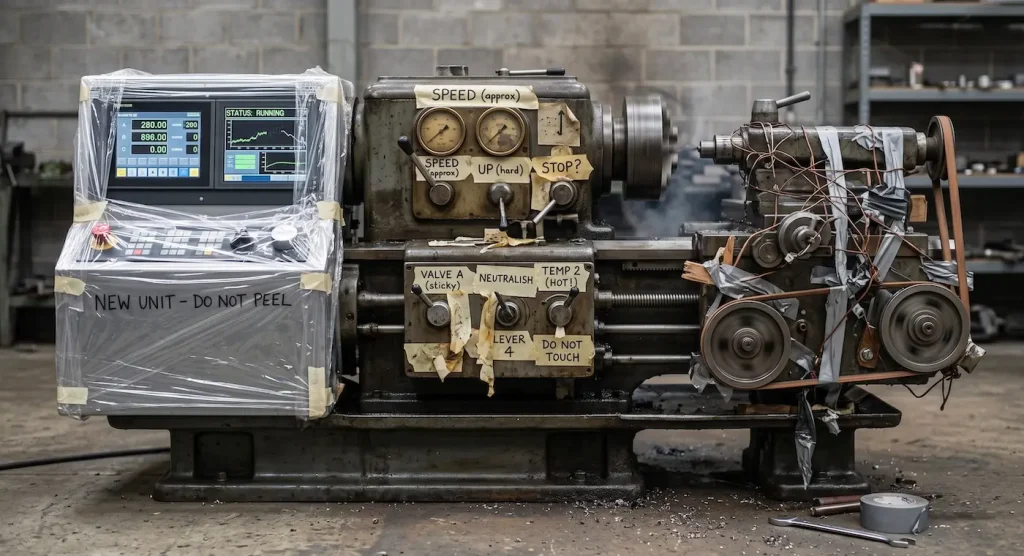
An ERP isn’t a system. It’s a tool that makes some things faster in a dysfunctional environment, but it doesn’t fix the dysfunction. It won’t shorten lead times. It won’t eliminate hours of people doing work with no added value.
Before ERP, we need to know which processes we’re digitising. Otherwise we’re digitising chaos. And digital chaos is, at the end of the day, far more expensive than the analogue kind.
Good IT infrastructure follows process order. Not the other way around.
The Process Map Nobody Uses
Every company we walk into has its processes. Most of them live in the head of a veteran foreman, some are in a spreadsheet nobody updates, a few are in a system nobody uses.
When we ask “How does this work here?”, three different people give three different answers. Everyone has their own version of the truth, nobody knows the whole picture.
And that’s exactly where the company is losing money. Not visibly, not dramatically all at once, but every day. In handovers between shifts, in approvals waiting on one person, in checks that are duplicated because there’s no trust that the person before you did it right.
The first thing we do with every client: we map reality. Not how it should be, just how it actually is. It usually surprises us. It surprises the client too.
The Biggest Opponent of Change Isn’t Who You Think
When we talk to owners about change, we usually know who “will be the problem.” The veteran foreman who’s been here twenty years. The manager protecting her territory. The salesperson who won’t use the CRM.
In practice, it’s often not who we expected.
The most common opponent of change is quiet. Doesn’t complain, attends the meetings, says yes, and then carries on exactly as before. Not out of malice, but because they don’t understand why. Why now, why this way, and what’s in it for them.
Change that doesn’t answer these questions won’t meet with resistance. It will meet with quiet ignorance, and that’s far worse. Resistance you can see. Ignorance you can’t.
That’s why the psychology of change isn’t a soft add-on to process work. It’s the infrastructure without which the process work simply won’t survive.
Where Do You Start?
Three layers, three different types of problems, and one pattern of failure: change made in parts, or only in one layer at all.
IT without processes is an expensive toy. Processes without people who accept them are just another document nobody reads. And people without systems that make sense to them will create their own ones that work for them, not for the company.
The question we hear very often is “Where do we start?” The honest answer: you won’t know without looking inward. Not intuitively, systematically.
Many owners know something isn’t working. Few know exactly where and why. And that’s the difference between change that costs something and change that actually changes something.