
Motivation Is a Con. And You Already Know It.
I was a young manager, not yet thirty, with a full shelf of books where people on the covers stared into the distance as if they could see their own reflection on the horizon. I read them. Underlined them. For a while, I even believed some of them.
I know the terminology well. Growth Mindset. Radical Responsibility. Be Your Best Self. Abundance over Scarcity. I can talk about it for hours with a straight face.
And here’s the thing nobody in that industry wants to say out loud:
Motivation is a feeling. Feelings are like weather.
You don’t build a production line on weather. At six in the morning, you don’t go open the shop floor because you feel inspired. You open it because the shift starts at six and someone is waiting.
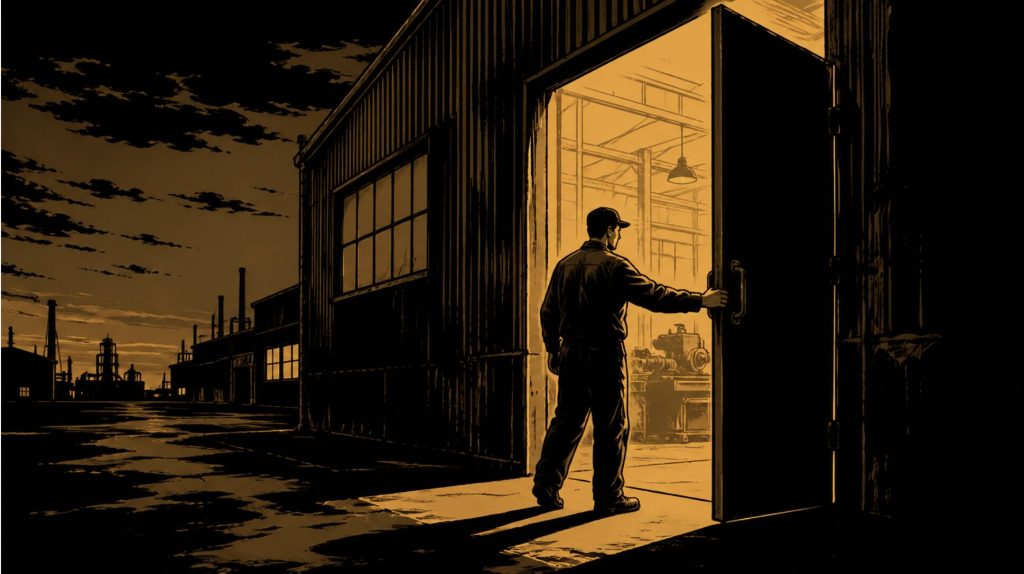
The entire motivation industry rests on one fundamental mistake: the assumption that the right internal state produces results. It doesn’t. Results are a product of systems. Of deadlines. Proper handovers, documented procedures, accountability that doesn’t depend on anyone’s mood — that’s what produces results. Motivation, at best, occasionally shows up and takes the credit.
James Clear summed it up in Atomic Habits with one sentence that should hang in every boardroom: “You do not rise to the level of your goals. You fall to the level of your systems.”
I’ve seen passionate founders who achieved almost nothing because inspiration was the plan. And I’ve seen tired, sometimes irritable operators who ran a working system and came out the other side with something real in their hands. Clean balance sheet. A process that actually runs. A team that doesn’t need to be re-motivated every Monday.
Gurus will tell you that second group just hasn’t found their why yet. I’d argue they found something better: they stopped renegotiating with themselves every single morning.
A system isn’t running away from yourself. It’s protecting your better self from your worse self.
The Stoics knew this. Discipline isn’t suppression of feelings — it’s a decision made in a moment of clarity that holds even when the clarity is gone.
A system is a record of your best judgment. From the moment when you were rested, focused, thinking strategically. That record holds on a Tuesday at six in the morning, when your inbox is full of emails that get under your skin and half of your warehouse didn’t show up.
Stop asking your nervous system for permission. Take it as: my system is a decision I already made with a clear head. Now I’m just executing it.
It’s the difference between those who run from themselves and those who keep their word to themselves.
What actually works
Observed from real SMB owners — manufacturing, trading — who can’t afford a morning ritual because the first shift starts before most motivational speakers get out of bed.
Narrow your decision frame.
Don’t ask whether you feel like it. Ask: what’s the next concrete action? Motivation dissolves in vagueness. “Improve the company” is a thought. “Call Mark before lunch about the complaint” is a task. One of them will happen. Take a guess which one.
Design your system for your worst Tuesdays.
It has to work when you’re tired, when someone sends you an email that makes your eye twitch, and the machine on line 2 is making that sound again. If your process only works when you’re fired up — it’s not a process. It’s a mood with a to-do list.
Use time pressure honestly.
Not “I’ll take a look at it.” A block in the calendar. A person who is waiting. An external frame. A calendar is more reliable than willpower. I have yet to see a serious business built on willpower alone.
None of this is inspiring. That’s exactly the point.
The bottleneck isn’t always in your head. Sometimes it’s a calendar with no structure. Sometimes cash flow you never properly modeled. Sometimes a process that breaks down every third Thursday for a reason nobody ever wrote down. These are concrete, solvable problems.
Your mindset? That’s like renovating a house with no completion date. With a contractor who keeps pushing their deadlines.
Jocko Willink put it with brutal simplicity: “Don’t rely on motivation. Rely on discipline.” That’s not a motivational quote. That’s an operational directive — and the only thing that’s truly in your hands.
Fix the process first.
Motivation, if it ever shows up, can walk alongside you. Character: build that every day.